越光宝盒
China reports 522,000 new COVID-19 cases, one death in July amid fluctuating upward trend_我的网站

A |

Photo: VCG
China reported 522,000 newly confirmed COVID-19 cases in July, including 487 severe cases and one related death with cases showing a fluctuating upward trend, China's national disease control authority said.
The current uptick in infections represents another regular cyclical wave, with its severity comparable to surges seen in the past two years. The upward growth curve has slowed markedly, and the country is now on the plateau phase of this epidemic peak, said the Chinese Center for Disease Control and Prevention (Chinese CDC) on Thursday.
All tested infection samples were confirmed to be the Omicron variant, with the NB.1.8.1 strain and its sublineages accounting for the majority of circulating cases, the Chinese CDC said.
A Beijing-based respiratory disease specialist told the Global Times that waning population immunity, continued virus mutations that weaken existing antibody protection, and increased summer travel have contributed to the recent modest rise in infections. However, there is no evidence that the virus has become more pathogenic. Nationwide infections appear to be nearing their peak and case numbers may begin falling in late August.
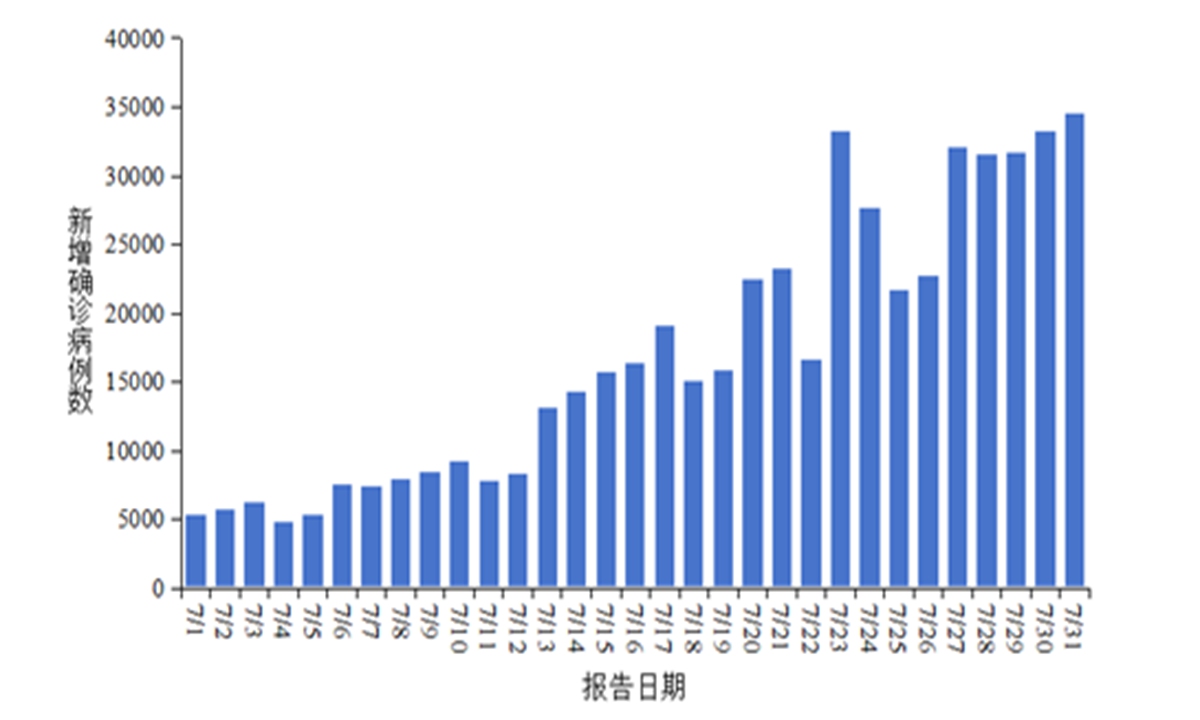
A screenshot from Chinese CDC report on new COVID-19 cases in July nationwide
According to sentinel hospital surveillance data, from June 29-July 5 to July 27-August 2, the proportion of influenza-like illness among all outpatient and emergency visits at China's 1,041 COVID-19 and influenza sentinel hospitals edged up with slight fluctuations, standing at 4.3 percent, 4.4 percent, 4.5 percent, 4.4 percent and 4.5 percent, respectively.
During the same period, the COVID-19 positivity rate among patients with influenza-like illness in outpatient and emergency departments rose for consecutive weeks.
Several factors drove the fluctuating rise in COVID-19 cases in July. Population immunity has waned, as more than six months have passed since the last major wave of infections for most people, while continued SARS-CoV-2 mutations have reduced the protection provided by existing antibodies, Li Tongzeng, a respiratory disease medic from Beijing You An Hospital to the Capital Medical University, told the Global Times on Friday.
These factors, combined with increased travel and population mobility during the summer vacation, contributed to the recent small-scale surge. Based on patterns observed in recent years, COVID-19 infections tend to rise every six to eight months as population immunity declines, said Li.
The expert noted that while the virus continues to mutate, there is no evidence that it has become more pathogenic. Clinical data show that most patients develop only mild symptoms, with very few progressing to pneumonia or requiring hospitalization.
The Chinese CDC noted on Thursday that since COVID-19 was reclassified as a Category B infectious disease under Category B management, it has evolved into a prevalent, recurring respiratory infectious disease in China, with one to two epidemic fluctuations occurring nationwide each year.
Li also noted that residual immunity from previous infections also helps reduce disease severity, with most reinfections presenting as mild upper respiratory symptoms that resolve within about a week. The single COVID-related death reported nationwide in July further indicates that the current fatality rate remains very low.
Judging from historical epidemic patterns and current case growth trajectories, national infection figures may begin to decline in late August. Nationwide case numbers are now nearly at their peak, with declines already observed in some regions, said Li.
The Chinese CDC also said on Thursday that surveillance had not detected any variants posing major public health risks, nor had the current wave caused notable disruptions to the healthcare system.
The public is advised to take appropriate protective measures, including wearing masks when necessary, maintaining good personal hygiene, adopting healthy lifestyles and getting vaccinated as recommended.
。 8 月 26 日消息,据上海广播电视台 8 月 25 日报道,两名男子利用某新能源车企 App“先充后付”功能的规则漏洞,通过 870 多个虚拟手机号反复绑定子账号充电后拒不付款,再将“免费充电位”倒卖给大货车司机,不到一个月累计造成车企电费损失超 40 万元。上海市浦东新区人民检察院认定两人行为已构成诈骗罪,目前已对嫌疑人梁某、张某批准逮捕。注意到,该新能源车企推出的“先充后付”功能允许车主通过 App 绑定多个子账号,每个子账号可享受两次“先充电、后付款”的额度,在第三次充电后统一结算。嫌疑人梁某与张某在一个顺风车群中相识,梁某了解到张某的新能源车品牌后,要求张某将其提供的虚拟手机号授权为 App 共同用车人。在确认充电账单仅发送给子账号、与主账号无关后,两人商定利用该漏洞非法获利。

B | 梁某从网络平台购买了 870 多个虚拟手机号,每日向张某支付 800 元报酬,让其反复执行“绑定子账号、充电两次、立即解绑”的操作。随后梁某将这些“免费充电位”挂在网上,以每单 80 至 120 元的价格转卖给大货车司机。

C | 梁某交代,一辆重卡充满电约需 600 度电、耗时 3 小时,因其提供的充电价格低廉,已积累了不少固定客户。今年 5 月,涉事车企排查时发现某主账号名下异常频繁地更换了 870 多个子账号,每个子账号均为充电两次后即解绑。从 4 月至案发,累计未支付电费已超过 40 万元,向子账号发送的催缴通知均未收到任何回复。

D | 5 月 20 日,涉事公司向警方报案,梁某、张某随后落网。上海市浦东新区检察院认定,两人虽实施的是窃电行为,但所涉罪名为诈骗罪而非盗窃罪。

E | 检方认为,二人利用虚拟手机号骗取车企充电服务,使企业“认错人”而白掏电费,符合诈骗罪“虚构事实、隐瞒真相、以非法占有为目的”的构成要件。在讯问中,梁某和张某均表示愿意积极退赔,梁某称其妻子已将家中房屋挂牌出售,愿用卖房款赔偿涉事车企的全部损失。

F | 广告声明:文内含有的对外跳转链接(包括不限于超链接、二维码、口令等形式),用于传递更多信息,节省甄选时间,结果仅供参考,包含外链的文章均包含本声明。
Current article:http://sm25.diapoqiechuangpenghua.sbs/list_cwp/tz08t.html
Published on:07:56:18


 Humanoid robots take to Beijing pitch in autonomous football qualifiers
 香港首个五年规划9月16日公布
 正在直播!国足对阵库拉索,冲击胜利,邵佳一首秀,CCTV5助力
 Nothing Ear(3a)图赏:透明工业风,极具表现力
 英雄联盟职业联赛:TES夺得夏季赛常规赛冠军
 亚美尼亚和阿塞拜疆边境地区发生冲突 亚总理与俄总统通话


