
七侠五义
[속보] 국토장관 "용산공원 관련 서울시와 의견접근 안되고 있어"_我的网站

A |
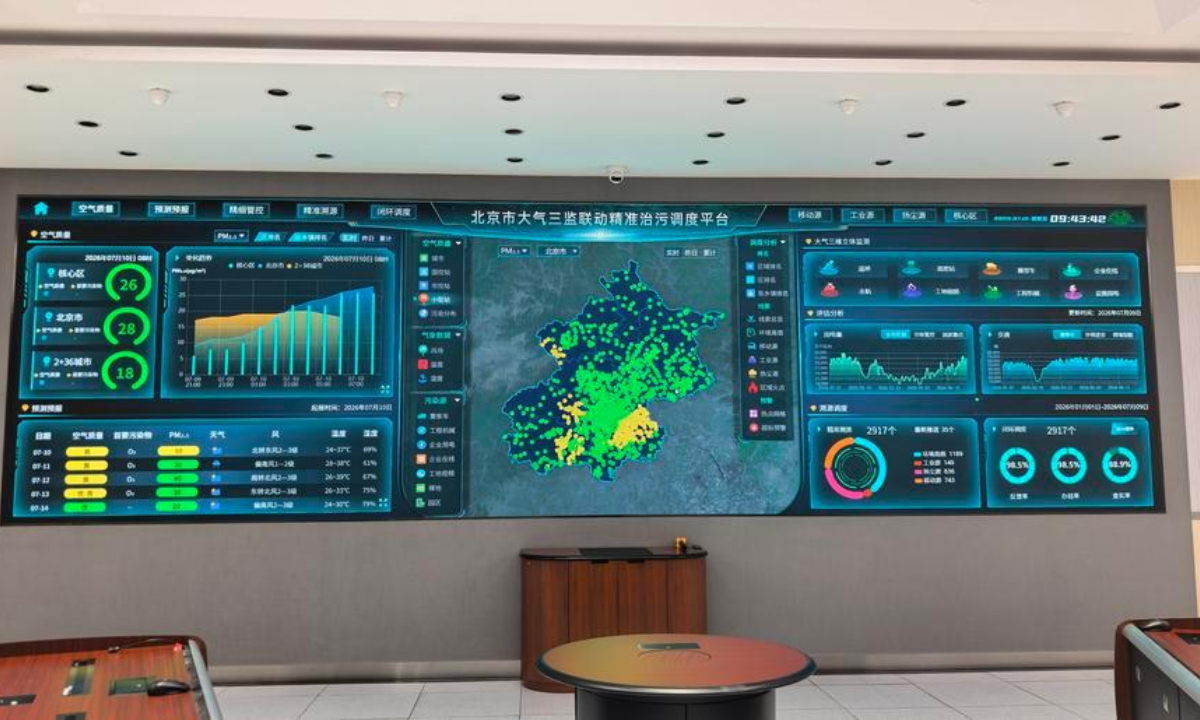
In 2025, Beijing recorded 311 days with good air quality and only one heavily polluted day, compared with 58 heavily polluted days in 2013, when the city officially began releasing PM2.5 monitoring data. The annual average PM2.5 concentration, a key indicator of air quality, fell from 89.5 micrograms per cubic meter in 2013 to 27 micrograms per cubic meter in 2025, a decline of nearly 70 percent.
The progress has drawn international attention. The United Nations Environment Programme has highlighted Beijing's experience in improving air quality as a model for other cities.
According to experts at the Beijing Municipal Ecological and Environmental Monitoring Center, the cleaner air is the result of a comprehensive system integrating environmental monitoring, scientific analysis, policymaking, regional cooperation and law enforcement -- with digital technologies now woven into every link of that chain.
MORE TARGETED APPROACH
Effective governance begins with accurate monitoring. Beijing has established a multi-level air-quality monitoring network. Figures show 35 standard monitoring stations across the city continuously measure six major pollutants, while more than 1,000 compact sensors deployed across communities and townships provide more detailed information on local air-quality variations.
The monitoring system was gradually built by the Beijing Municipal Ecological and Environmental Monitoring Center, one of China's earliest ecological and environmental monitoring institutions, responsible for monitoring Beijing's air, water, noise, soil environments and ecosystems.
The center has developed an analytical system that can identify around 125 components of PM2.5, covering most of its composition and helping researchers trace pollution sources.
"Source analysis helps us identify the major contributors to pollution at different stages, providing a scientific basis for policymakers to target key emission sources," said Li Yunting, technical director at the center.
Coordinated by the Beijing Municipal Ecology and Environment Bureau, the center has conducted four rounds of PM2.5 source analysis studies with other institutions, with results released in 2014, 2018, 2021 and 2025.
The latest analysis showed that regional transport contributed 57 percent of Beijing's PM2.5 pollution. Among local sources that accounted for the remaining 43 percent, vehicle emissions and residential sources represented the largest share of pollution, a distinctive characteristic of a major international metropolis.
The monitoring results have provided scientific support for a series of pollution-control measures. For example, Beijing has promoted new-energy vehicles to reduce transport emissions and adopted advanced techniques, including air-supported membrane structures, to control dust emissions. Meanwhile, coal combustion pollution, once a major contributor, has almost been eliminated and is no longer listed among the main sources, reflecting broader national efforts to reduce coal consumption, promote clean energy and upgrade heavily polluting industries.
With PM2.5 concentrations now at relatively low levels, further gains in air quality will depend on more targeted, science-driven approaches.
SMARTER ENVIRONMENTAL GOVERNANCE
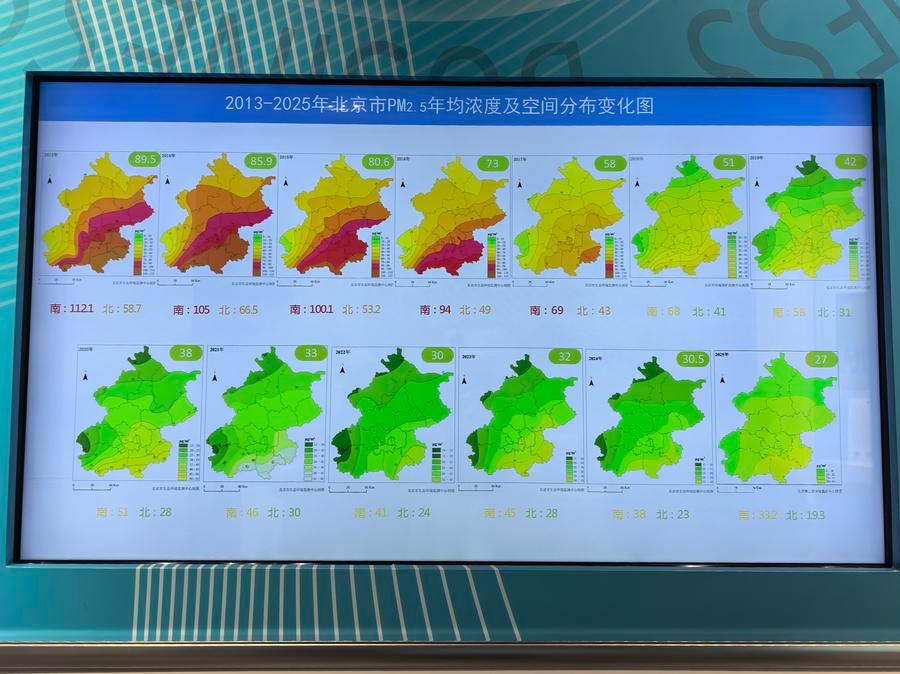
Beyond monitoring pollution, Beijing has built a data-driven environmental governance system that links monitoring, regulation and enforcement in a closed loop from detection to action and follow-up evaluation.
Developed by the center and known as the innovative regulation-monitoring-inspection linkage model, the system integrates artificial intelligence, the Internet of Things, satellite remote sensing and vehicle-mounted monitoring technologies to pull together environmental data from multiple sources onto a unified platform.
"The system brings information that was once scattered across different departments onto a single platform," said Zhang Likun, director of the smart system division at the center, adding that this enables off-site enforcement and joint cross-sector actions involving housing, water resources and transportation, significantly improving the efficiency and precision of environmental management.
Using more than 30 intelligent algorithms, the platform automatically analyzes data and identifies potential pollution risks, based on which monitoring staff identify the most pressing problems and forward them to enforcement departments.
The approach has already drawn international attention. Clean Air Asia, an international nongovernmental organization focused on improving air quality across Asia, featured the system as a representative case study in its "China Air 2025" report. The model was also presented at the 2026 Better Air Quality Conference and recognized with the Certificate for Clean Air Best Practice Sharing.
China has integrated ecological conservation into its modernization drive. As the country speeds up efforts under the Beautiful China Initiative, Beijing's experience demonstrates how technology can support more precise, coordinated and sustainable environmental governance.
。 연합뉴스TV 속보(CG) [속보] 국토장관 "용산공원 관련 서울시와 의견접근 안되고 있어"#국토부 #용산공원 #서울시연합뉴스TV 기사문의 및 제보 : 카톡/라인 jebo23。
Current article:http://sm25.diapoqiechuangpenghua.sbs/news/20260826_98605.html
Published on:07:28:58
 梅开二度,重庆铜梁龙队长向余望当选中甲第4轮最佳球员
 入坑即毕业!魔域口袋版是怎么布局启世服的?
 京东618活动6月17日晚8点开始买最便宜!2025京东618最新红包口令是:红包到手798
 从“卖床”到“运营睡眠数据”:麒盛科技的软件叙事走到哪了
 Anil Sharma Reveals Fate of Dharmendra, Sunny Deol and Bobby Deol Starrer Apne 2
 2026年企业IT运维监控与可观测平台选型:四类主流产品功能与价格深度对比