出发吧爱情
宮根誠司、『Mr.サンデー』政党記載漏れ謝罪時に見せた“他人事態度”が物議…過去にも“偉そうな謝り方”で疑われたMCの適性_我的网站

一 |
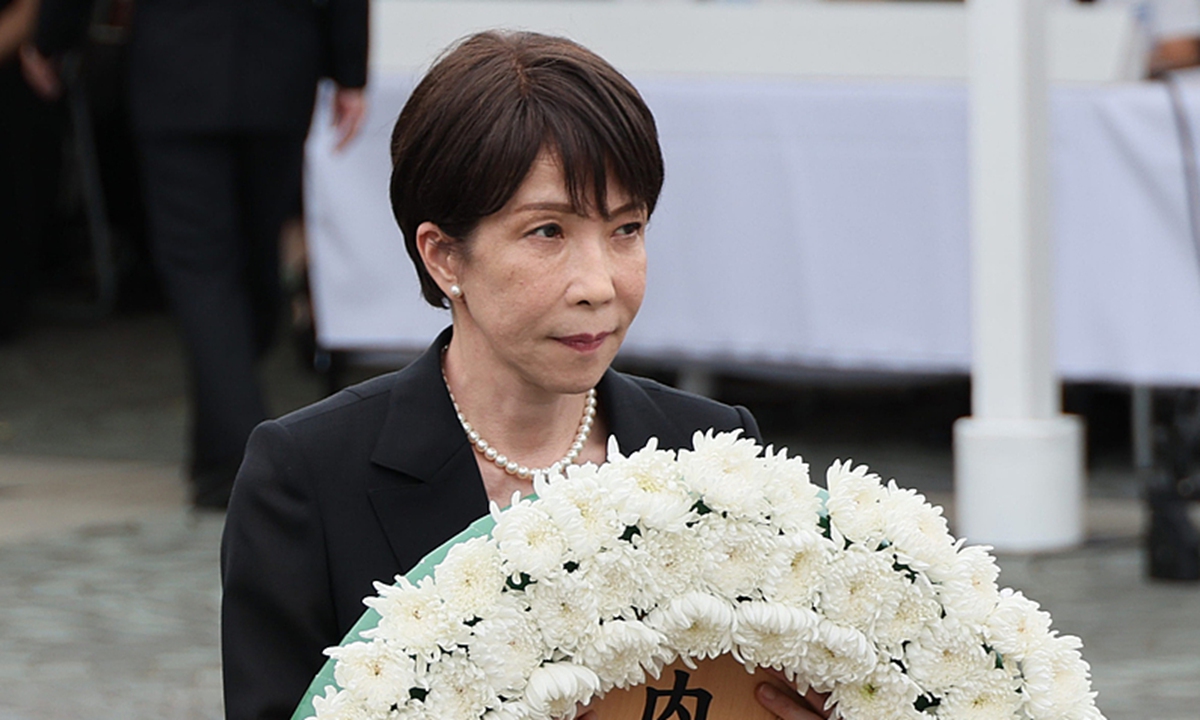
Japanese Prime Minister Sanae Takaichi attends a Nagasaki Peace Ceremony to commemorate the 81st anniversary of the atomic bombing at the Peace Park in Nagasaki City on August 9, 2026. Photo: VCGJapanese officials and members of the public urged the government to uphold the Three Non-Nuclear principles and pursue a security policy that does not rely on nuclear weapons, as Prime Minister Sanae Takaichi maintained an ambiguous stance on the long-held policy during a speech on Sunday marking the 81st anniversary of the US atomic bombing of Nagasaki.
Chinese experts noted that, similar to her ambiguous remarks at the memorial ceremony in Hiroshima, Takaichi stopped short of making a clear commitment to maintaining the Three Non-Nuclear Principles in the future, as her government's stance on nuclear issues has sparked concern and anger among the Japanese public. They also warned that, given Japan's lack of thorough reflection on its wartime aggression, Tokyo's moves to dilute the Three Non-Nuclear Principles should raise alarm across the international community.
"Our country firmly upholds the three non-nuclear principles, and under the pledge that 'Nagasaki shall be the last city to suffer a nuclear attack,' we are promoting realistic and practical initiatives toward the realization of a world without nuclear weapons," Takaichi claimed, according to the Japan Times.
But unlike previous prime ministers, many of whom had pledged that Japan would "continue to uphold" the principles, Takaichi merely described the government's current position without making an explicit commitment about the future, per the report.
As Hiroshima observed the 81st anniversary of the US atomic bombing of the city on Thursday, Takaichi also emphasized that Japan pledges to achieve a world free of nuclear weapons while upholding the Three Non-Nuclear Principles, despite Japanese media noting that she has left the door open for future revisions.
Takaichi's remarks in Hiroshima and Nagasaki that Japan upholds the three non-nuclear principles were largely seen as a reaffirmation of the country's existing policy position rather than a pledge to maintain the principles in the future, Liu Jiangyong, a professor at the Institute of International Studies at Tsinghua University, told the Global Times.
Liu said that currently, some Japanese officials' dangerous remarks on nuclear have sparked criticism among Japanese society. He pointed out that Takaichi only referred to Japan's current adherence to the principles, without explicitly committing to preserving them going forward. Her subsequent focus on broader goals such as achieving a "world without nuclear weapons" has further fueled questions over her actual policy intentions.
Japanese Defense Minister Shinjiro Koizumi claimed in an online program released in July that discussions on nuclear weapons were necessary to strengthen Japan's defense capabilities, according to Kyodo News. While acknowledging that the issue was difficult to discuss in Japan, he claimed it was something that "could not be avoided."
Opposition to the Takaichi administration's nuclear-related moves has emerged across Japan, including from local governments, media organizations and civil society groups.
According to statistics from the Japanese Diet, at least 128 local assemblies across the country had submitted written opinions to the central government or parliament between Takaichi's inauguration on October 21 last year and July 28 this year, calling for the country's Three Non-Nuclear Principles to be upheld, according to Xinhua News Agency.
In an interview with the AFP, 82-year-old Satoshi Tanaka, a campaigner who survived the 1945 attack on Hiroshima expressed frustration that current political leaders like Takaichi are focusing on military capacity at the expense of diplomacy.
"There is so much talk about national security. What about building peace through diplomacy?" he said.
Responding to a question concerning the Japanese authorities are rebuilding Japan's war machine, seeking to revise the Three Non-Nuclear Principles, and pursuing nuclear sharing with the US, even the possession of nuclear weapons, Chinese Foreign Ministry spokesperson Lin Jian said on Thursday that the devastation and tragedies brought by nuclear weapons should never repeat themselves. That said, the particular context of the nuclear explosions should all the more be remembered and the lessons of Japanese militarism's aggression and expansion must forever serve as an alarm.
The Tokyo's moves on nuclear policy have also raised concerns in the international community.
Russia considers the rhetoric of Japanese authorities regarding the need for Japan to revise its Three Non-Nuclear Principles provocative and unacceptable, Russian Ambassador to Japan Nikolai Nozdrev said in an interview with RIA Novosti, which was published on Saturday.
Responding to Koizumi's remarks on nuclear discussion, Nozdrev said "This is the first time in Japan's history, as the only country to have suffered atomic bombings in Hiroshima and Nagasaki, that a sitting defense minister has publicly called for lifting the 'taboo' on discussions related to nuclear weapons. We consider such rhetoric from official Tokyo provocative and absolutely unacceptable."
Japan has yet to fully reckon with its wartime aggression, thus any attempt by Tokyo to move toward acquiring nuclear weapons could pose serious risks to regional peace and global security, Lü Chao, an expert on the Korean Peninsula issue at the Liaoning Academy of Social Sciences, told the Global Times.
Such concerns have become more pronounced as Japan increasingly portrays China as a major security challenge while highlighting perceived threats from other countries, against such a backdrop, any further steps to dilute the three non-nuclear principles are likely to heighten concerns internationally, particularly among countries that suffered from Japanese aggression during World War II, said Lü.
。

二 | 2月22日、宮根誠司と藤本万梨乃が司会を務める情報番組『Mr.サンデー』(フジテレビ系)で、衆院選に関する放送内容について謝罪した。

三 | ただ、番組内での宮根の態度が物議を醸している。

四 | 【画像あり】宮根誠司が謝らなかった『Mr.サンデー』の“政党記載漏れ” 問題となったのは、15日放送の衆院選に関する特集企画だ。「番組内で11議席を獲得したチームみらいを取り上げました。その際、比例東京ブロックの政党別得票率の一覧表を紹介したのですが、日本保守党と減税日本・ゆうこく連合だけ記載がなく、放送直後からSNSで2党の記載漏れが指摘されていたのです。19日には番組公式サイトで謝罪文を掲載しましたが、今回の放送で改めて謝罪したかたちです」(スポーツ紙記者) 番組中盤、藤本が「前回の放送で、先におこなわれた衆議院選挙に関するニュースを取り上げた際、比例代表東京ブロックにおける政党ごとの得票率を紹介しました。この一覧表に、日本保守党と減税日本・ゆうこく連合が記載されていませんでした」と、記載漏れを謝罪。正しい表を映しながら、今後の再発防止を徹底することを表明した。 ただ、放送後のXでは 《宮根さんは謝らないのね。

五 | 頭下げるくらいしてもいいのでは》 《「はい、次はこちらです」じゃ、ねーよ。ひとごとか?宮根?》 《藤本万梨乃アナのお詫びが言い終わらないうちに宮根誠司が「さあ続いては」とかぶせたのは駄目だろう》 など、宮根に厳しい声が聞かれていた。宮根の“他人事態度”が波紋を呼んでいるようだ。「藤本さんが『再発防止を徹底してまいります』と言って頭を下げたのですが、宮根さんは謝罪せず、彼女が頭を上げる前に『はい、続いてはこちらです』と、被せるようにミラノ・コルティナ五輪の話題に移行したのです。今回の件は、宮根さんに問題があったわけではありませんが、番組の司会者として謝らず、何事もなかったかのように進行する様子に違和感を覚える人が多かったようです」(芸能記者) 宮根は『情報ライブ ミヤネ屋』(読売テレビ制作、日本テレビ系)と『Mr.サンデー』でMCを務め、情報番組の顔として広く認知されている。ただ、“謝り方”が物議を醸したのは、今回が初めてではない。「2024年3月の『ミヤネ屋』で、宮根さんは韓国で開催されたメジャーリーグの取材の際、喫煙禁止区域で喫煙したことを謝罪しました。『周りの方々、それから多くの方々にご不快な思い、ご迷惑をおかけしました』と述べながら頭を下げたのですが、宮根さんはスタジオのセットである机に手を大きく広げたままだったのです。 この態度に関して、SNSで『机に手をついて偉そうに謝罪してる人の態度じゃないよ』と批判の声があがってしまいました。今回の件もあわせると、番組の“顔”としての適性に疑問を持たれかねませんよ」(同前) MCとして、お茶の間から“支持”される言動を期待したいが……。
Current article:http://sm25.diapoqiechuangpenghua.sbs/tyb/20260826/828538.html
Published on:09:27:46
 河北出台自然岸线占用补偿管理办法
万水千山总是情
河北出台自然岸线占用补偿管理办法
万水千山总是情
 党建领航促发展 夯实基础谱新篇——市中院上半年党建工作综
朝5晚9
党建领航促发展 夯实基础谱新篇——市中院上半年党建工作综
朝5晚9
 剑桥科技:上半年净利润3.28亿元,同比增长171.08%
模范秘书
剑桥科技:上半年净利润3.28亿元,同比增长171.08%
模范秘书
 算力全链条绿色化成效初显 词元经济等成新增长极
凤凰男
算力全链条绿色化成效初显 词元经济等成新增长极
凤凰男
 速卖通登顶巴西购物榜,8月销售额大涨85%
全城热恋
速卖通登顶巴西购物榜,8月销售额大涨85%
全城热恋
 “油菜花田”播种忙
鸿门宴
“油菜花田”播种忙
鸿门宴

 微信
微信 移动端
移动端


